


Business bandwidth is the amount of data an internet connection can carry in a given time. More capacity can support cloud applications, calls, file transfers and connected teams. However, the best business connection is not simply the package with the largest headline speed. Reliability, upload performance, latency, resilience and support also affect everyday results.
What is business bandwidth?
Bandwidth describes connection capacity and is usually measured in megabits or gigabits per second. Download bandwidth covers data received by the business. Upload bandwidth covers data sent to cloud services, customers or colleagues.
Speed and bandwidth are related, but they are not identical. A high-capacity connection can carry more simultaneous activity. Even so, an individual application may still feel slow when latency is high, Wi-Fi is weak or the internal network is congested.
How does better bandwidth improve business performance?
Clearer calls and video meetings
Cloud calling and video meetings need steady two-way connectivity. Therefore, strong upload performance matters as much as download speed. Sufficient capacity can reduce competition between calls, file transfers and other applications.
A dedicated leased line connection can provide symmetrical speeds and committed service levels for organisations with demanding or business-critical workloads. Meanwhile, services such as video conferencing and VoIP (Voice Over Internet Protocol) calls also benefit from low latency, low jitter and sensible network prioritisation.
Faster cloud and file workflows
Many organisations store documents, back up systems and run software in the cloud. As a result, employees constantly send and receive data. More usable bandwidth can shorten large transfers and help several people work online at the same time.
However, capacity should match the real workload. An SME News article explores the potential of 10Gbps connectivity for data-intensive organisations.
A smoother customer experience
Reliable connectivity helps teams answer enquiries, access customer records and process online transactions without avoidable delay. In addition, it supports websites, contact centres and hosted platforms behind the scenes.
Customers do not usually think about bandwidth directly. Instead, they notice responsive service, stable calls and quick answers. Therefore, connectivity planning should start with the customer journey and the applications that support it.
Room for growth
New employees, locations, devices and cloud tools all add traffic. Consequently, a connection that works today may become constrained as the organisation changes. Regular reviews can identify rising demand before it affects productivity.
Which connection metrics matter besides download speed?
Upload speed
Upload capacity is important for cloud backups, sending large files, hosting services and video calls. Therefore, businesses that create or share a lot of data should compare upload figures carefully.
Latency and jitter
Latency is the time data takes to travel across the network. Jitter is variation in that delay. Both can affect real-time applications, even when the connection has plenty of bandwidth. For example, a fast service with unstable latency may still produce broken audio.
Contention and consistency
Some broadband services share network capacity with other users. Therefore, performance can vary at busy times. Ask whether quoted speeds are estimates, minimum guarantees or committed rates, and check whether upload and download speeds are symmetrical.
Uptime and service levels
When internet access is business-critical, recovery time matters. A service-level agreement may define availability, fault-response targets and repair commitments. However, the precise wording and exclusions are more important than a headline percentage.
Internal network performance
The internet circuit is only one part of the experience. Older switches, unsuitable routers, congested Wi-Fi and poor cabling can create bottlenecks. Therefore, test both the connection and the local network before ordering a faster service.
How much business bandwidth do you need?
There is no universal figure. First, list the applications the organisation uses and the number of people who use them at the same time. Next, identify peak activities such as video meetings, cloud backups, software updates and large file transfers.
Then consider the impact of growth and unexpected demand. A sensible plan includes spare capacity without paying indefinitely for bandwidth the business is unlikely to use.
Questions to assess include:
- How many people and devices are online during busy periods?
- Which applications are critical to sales, service or operations?
- How much upload traffic do backups and file sharing create?
- Do voice and video services require low latency and jitter?
- Would a short outage stop the organisation from trading?
- Are new employees, sites or cloud platforms planned?
FTTP or leased line: which is right for a business?
Fibre to the premises, or FTTP, delivers fibre to the building and can suit many small and medium-sized organisations. It usually provides strong download performance at a lower cost than a dedicated circuit. However, upload speeds, repair targets and performance guarantees vary by service.
A leased line is a dedicated business connection. It commonly offers symmetrical bandwidth, committed performance and stronger service levels. Therefore, it can suit organisations that depend on cloud systems, transfer large volumes of data or cannot tolerate lengthy outages.
The right choice depends on risk, workload, location, installation timescale and budget. Availability also varies by address, so compare solutions using site-specific information.
Why does broadband resilience matter?
A primary connection can fail because of equipment faults, accidental cable damage, power loss or wider network problems. For that reason, business continuity planning should include connectivity.
A backup service is most useful when it avoids the same points of failure as the primary circuit. For example, organisations may combine fixed fibre with a mobile or alternative fixed connection. Automatic failover can then move essential traffic to the backup service.
However, a backup only adds value when it is tested. Confirm that the router, power supply, authentication and critical applications still work during a simulated failure.
How can a business improve bandwidth without changing provider?
- Measure performance at different times using a wired connection.
- Review router, switch, cabling and Wi-Fi capacity.
- Prioritise voice, video and other real-time traffic where appropriate.
- Schedule large backups and software updates outside peak periods.
- Remove unused cloud sync tasks, devices and applications.
- Separate guest access from operational traffic.
- Investigate faults before assuming the package is too small.
These steps can reveal whether the problem is internet capacity, local infrastructure or application design. As a result, the business can invest in the right fix.
What should you ask a business broadband provider?
Ask for expected download and upload performance at the specific premises. In addition, request details of minimum guarantees, contention, service levels, installation lead times and support hours.
Also clarify equipment ownership, security options, static IP addresses, monitoring and backup connectivity. Finally, confirm the full contract cost, including installation, hardware and early termination terms.
Business bandwidth: the key takeaway
Better business bandwidth can improve collaboration, cloud access, data transfer and customer service. Nevertheless, capacity is only one part of a dependable connection. Compare upload performance, latency, consistency, resilience and support alongside headline speed.
Start with how the organisation works, measure current demand and plan for realistic growth. That approach connects technology investment to better business outcomes.
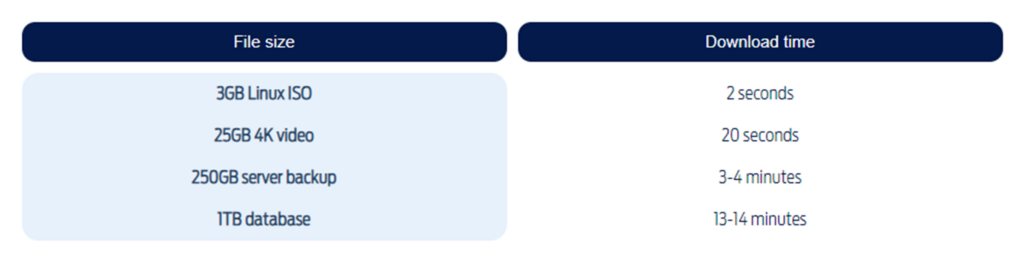
This lightning-fast speed can save a huge amount of crucial company time.
With cloud-based services, such as Software-as-a-Service (SaaS), Infrastructure-as-a-Service (IaaS), and Platform-as-a-Service (PaaS), companies can streamline their operations, reduce costs, and scale their IT infrastructure according to their needs. These cloud-based solutions demand a robust and high-speed internet connection to ensure uninterrupted access and maximise productivity.
Seamless Customer Experience
High bandwidth plays a significant role in delivering a seamless and satisfactory experience to your customers. Whether it’s a fast-loading website, smooth online transactions, or responsive customer support, a high-speed connection ensures that your customers can interact with your business effortlessly.
A slow-loading website can drive potential customers away and harm your brand reputation. On the other hand, a fast and responsive website provides a positive user experience, enhances customer engagement, and increases the likelihood of conversions.
Embracing Technological Advancements
Technologies such as artificial intelligence, machine learning, augmented reality, and virtual reality rely on significant data processing capabilities and seamless connectivity. A high-speed internet connection empowers businesses to explore these technologies, improve operational efficiency, and offer innovative solutions to their customers.
Conclusion
In today’s digital world, speed is everything; slow speeds mean slow business. From efficient communication and collaboration to enhanced data transfer and accessibility, a high-speed internet connection empowers UK-based businesses to thrive in the digital age. By ensuring seamless customer experiences and embracing technological advancements, businesses can stay competitive, foster growth, and unlock new opportunities.