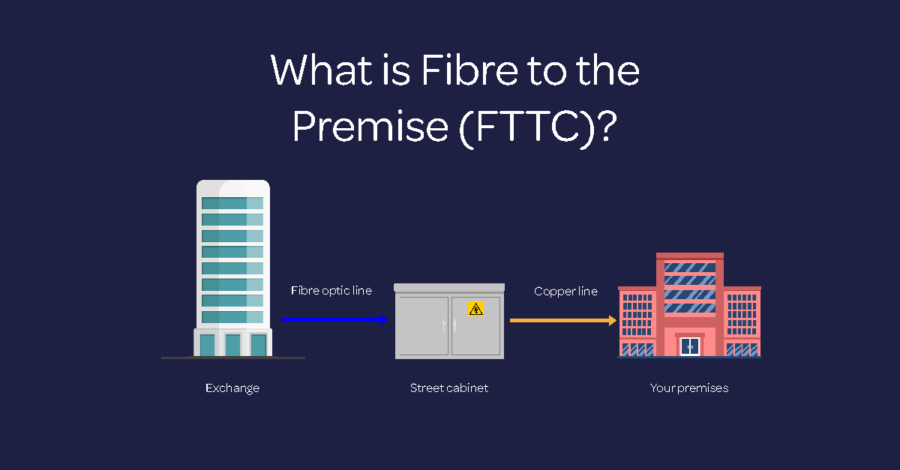
What is FTTC? FTTC stands for Fibre to the Cabinet. Fibre-optic cable carries data from the provider’s network to a street cabinet, while the existing copper telephone cable completes the journey to your home or business.
In practice, this mix of fibre and copper is why FTTC is often described as part-fibre broadband. It can provide a useful step up from older ADSL services without requiring a new fibre cable into every premises. However, its speed and stability depend heavily on the length and condition of the copper line.
How does FTTC broadband work?
First, data travels over fibre to the green street cabinet that serves the local area. Inside the cabinet, equipment transfers the signal to the copper pair running to your premises. A suitable router then connects computers, phones and other devices through Ethernet or Wi-Fi.
However, the copper section matters. Electrical signals weaken over distance, so a premises close to the cabinet may receive a stronger service than one farther away. The quality of the line, internal wiring and network demand can also affect performance.
FTTC is usually an asymmetric service, which means the download speed is higher than the upload speed. That suits ordinary browsing and streaming, but teams that send large files or use cloud backups may notice the lower upload capacity.
What speed can FTTC provide?
In turn, the available speed depends on the provider, package and copper line. Traditional FTTC services commonly offer headline download tiers up to around 80 Mbps, with lower upload speeds. The actual estimate for an address may be considerably lower if the premises is a long way from the cabinet.
When comparing options, use the address-specific estimate rather than the advertised maximum. Ask about the minimum guaranteed speed, where offered, and check whether the upload figure supports the way your team works.
Meanwhile, Wi-Fi can reduce the speed seen on individual devices. Before blaming the broadband line, test a computer connected to the router by Ethernet. This helps separate a connection problem from poor wireless coverage.
What are the advantages of FTTC?
Wide availability
Because FTTC uses much of the existing telephone network, so many UK premises can access it. Availability still varies by address, cabinet capacity and provider, so an exact line check is essential.
Lower installation requirements
Because the final connection uses the copper line already entering the building, installation is often simpler than fitting full fibre for the first time. In many cases, the provider can activate the service without major work at the premises.
Affordable for lighter business use
For example, FTTC can offer a practical balance of price and performance for a small team. It may handle email, web browsing, card payments and moderate cloud use comfortably, provided the line estimate is strong enough.
A clear improvement over ADSL
Moving the fibre closer to the customer reduces the length of copper used by the service. As a result, FTTC normally provides faster downloads and a more capable connection than broadband delivered entirely over copper from the exchange.
What are the disadvantages of FTTC?
Speed falls with copper line length
The farther the premises is from the cabinet, the more signal the copper line loses. Two businesses in the same area can therefore receive very different speed estimates, even when they buy the same package.
Uploads are relatively limited
FTTC prioritises download capacity. A low upload speed can slow cloud backups, large file transfers, video publishing and other tasks that send data away from the premises.
Performance can vary
FTTC is a shared broadband service. Busy network periods, line faults and local conditions may affect performance. It does not provide the dedicated bandwidth or service commitments associated with a leased line.
It offers less room for growth than full fibre
A business can add more users, cloud systems and connected devices surprisingly quickly. An FTTC line that feels adequate today may become restrictive as that demand grows.
What is the difference between FTTC and FTTP?
The difference lies in the final section of the connection:
- FTTC: fibre reaches the street cabinet, then copper runs to the premises.
- FTTP: fibre runs directly into the premises.
By contrast, FTTP removes the copper access line, so it can support higher speeds and stronger upload performance. Distance from the street cabinet is no longer the same constraint. It is generally the better long-term choice where it is available and affordable.
Even so, FTTC can still suit lighter use, particularly when the address has a strong line estimate or full fibre is not available. The right answer depends on actual demand, budget and the cost of a slow or unreliable connection.
What is SoGEA, and how does it relate to FTTC?
SoGEA stands for Single Order Generic Ethernet Access. It provides an FTTC-style broadband connection without a traditional analogue phone service. The copper line still carries data between the cabinet and the premises, but businesses do not need to buy a separate legacy phone package simply to receive broadband.
If the organisation needs phone calls, it can use a digital or hosted VoIP service over the internet. Check how alarms, lift lines, entry systems, card terminals and other connected equipment will work before changing an existing line.
Is FTTC the same as a leased line?
No. In short, FTTC is a shared broadband service that uses fibre to the cabinet and copper to the premises. A leased line gives one organisation dedicated bandwidth and normally provides the same speed for uploads and downloads.
In addition, leased lines include a business service level agreement with defined support and restoration targets. They cost more, but they are designed for organisations that depend on consistent connectivity. FTTC may be enough when internet use is lighter and occasional variation is manageable.
Can FTTC support VoIP and video calls?
Yes, if the line has enough download and upload capacity for the number of simultaneous users. A small team may use VoIP and video meetings successfully on a good FTTC connection. Problems are more likely when several calls, backups and downloads compete for limited bandwidth.
Moreover, router quality and local network design matter. Quality of Service settings can prioritise voice traffic, while good business Wi-Fi prevents weak coverage from being mistaken for a broadband fault.
Is FTTC right for your business?
FTTC may be suitable if your address has a strong speed estimate and the team has modest online requirements. It can work well when you:
- have a small number of active users;
- mainly use email, websites and light cloud applications;
- do not upload large files regularly;
- can tolerate some variation in performance; or
- cannot yet order a suitable full fibre service.
Consider FTTP, another full fibre option or a leased line if the business relies on constant cloud access, has many concurrent calls, sends large files or would lose significant time during an outage.
There is no useful rule based only on company size. A two-person design studio may need more upload capacity than a larger team using simple browser-based tools. Start with real usage, recurring problems and expected growth.
How to choose an FTTC package
Before signing a contract, compare more than the monthly price. Look at:
- the estimated download and upload speed for the exact address;
- minimum speed commitments and support hours;
- router and Wi-Fi specifications;
- contract length and early termination terms;
- whether a digital phone service is included;
- options for mobile or fixed-line backup; and
- the availability of FTTP at the same premises.
If full fibre is available for a similar overall cost, it may offer better long-term value. However, an FTTC service with a realistic speed estimate can still be a sensible choice when needs are straightforward.
FTTC FAQs
What does FTTC stand for?
FTTC stands for Fibre to the Cabinet. Fibre runs to a local street cabinet, and copper cable carries the service from there to the premises.
Why does distance from the cabinet matter?
The final part of an FTTC connection uses copper. The signal weakens over longer copper lines, which can reduce the speed available at the premises.
Does FTTC need a traditional phone service?
Not always. A SoGEA service can provide FTTC-style broadband without an analogue phone package. Calls can use a separate digital or hosted VoIP service.
Can FTTC provide symmetrical speeds?
Standard FTTC packages are usually asymmetric, with faster downloads than uploads. Businesses that need equal speeds should compare leased lines and suitable full fibre services.
Should I choose FTTC or FTTP?
Choose according to availability, speed, upload demand, support and budget. FTTP normally offers more capacity and room to grow, while FTTC may be sufficient for lighter use.