

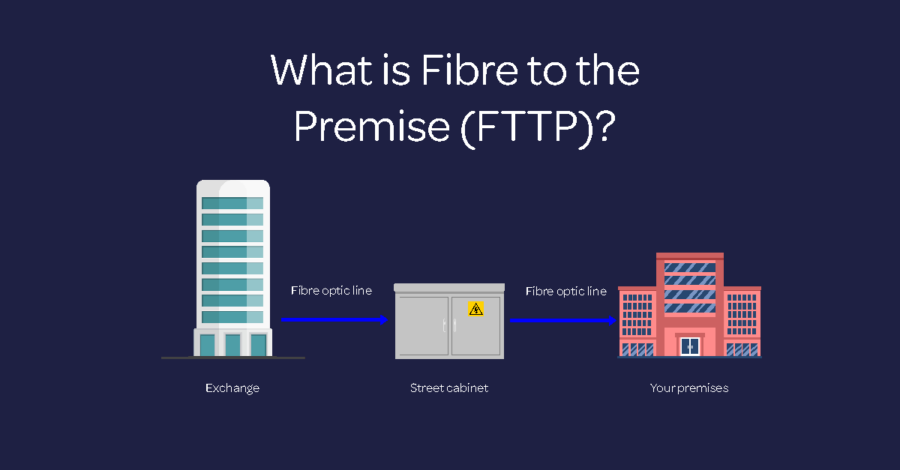
What is FTTP? FTTP stands for Fibre to the Premises. It is a full fibre broadband connection in which fibre-optic cable runs all the way from the provider’s network to your home or business. You may also see the term FTTH, or Fibre to the Home, used for residential services.
Because FTTP does not rely on the old copper telephone line for the final part of the journey, it can deliver faster and more dependable broadband than older services. That matters when several people are using cloud applications, video calls, online backups and internet-based phone systems at the same time.
How does FTTP work?
Data travels through thin strands of glass or plastic as pulses of light. The fibre runs from the wider network through local infrastructure and into an optical network terminal, often called an ONT, at your premises. A router then shares the connection with wired devices and Wi-Fi users.
With FTTP, the fibre reaches the building itself. There is no copper section between a street cabinet and the premises, so distance from the cabinet does not affect performance in the same way as it can with Fibre to the Cabinet.
The broadband package still sets the speed you receive. Providers offer a range of download and upload options, and the highest available tier varies by network and location. Your router, internal cabling, Wi-Fi coverage and the device in use can also affect real-world results.
What is the difference between FTTP and FTTC?
FTTP and FTTC both use fibre, but the final connection is different.
- FTTP: fibre runs all the way to the premises.
- FTTC: fibre runs to a street cabinet, then copper cable carries the service to the premises.
The copper section of FTTC limits speed and can make performance more sensitive to line length and quality. FTTP removes that section, which usually means higher speeds, stronger upload capacity and more consistent performance.
FTTC may still be suitable where full fibre is unavailable or a team has modest needs. However, FTTP gives growing organisations more headroom and provides a better foundation for cloud-based work.
What are the advantages of FTTP?
Faster downloads and uploads
FTTP supports a wider range of speeds than copper-based broadband. Large software updates, cloud files and online backups can finish more quickly. Upload speeds vary by package, so check both figures rather than looking only at the headline download speed.
More consistent performance
Fibre is less affected by distance and electrical interference than copper. As a result, the connection can deliver steadier performance to the premises. Network demand and local equipment still matter, but the access line itself is more capable.
Better support for busy workplaces
A modern office may have laptops, phones, payment terminals, security systems and smart devices online at once. FTTP provides the capacity to support that mix without one ordinary task bringing everything else to a halt.
Useful for cloud services and video calls
Microsoft 365, hosted phone systems, video meetings and cloud applications all depend on a responsive connection. Faster uploads are particularly helpful because people send data as well as receive it during calls and collaborative work.
A long-term replacement for copper broadband
UK networks are moving towards fibre and internet-based communications. Choosing FTTP reduces reliance on ageing copper access lines and gives the premises a connection that can support future speed upgrades.
What are the disadvantages of FTTP?
It is not available at every address
Full fibre coverage continues to expand, but availability depends on the individual postcode and sometimes the exact building. One side of a road may be ready before the other. Therefore, always run an address-level check rather than relying on a general coverage map.
Installation may need an engineer
If the premises has not used FTTP before, an engineer may need to route fibre into the building and fit an ONT. Access, landlord permission or work on private land can add time. It is worth discussing the cable route before the appointment, especially in a listed or shared building.
The fastest package is not always necessary
Very high speeds sound appealing, but they may cost more without improving everyday work. A small team does not automatically need the top tier. Start with the number of users, typical applications and upload requirements, then allow sensible room for growth.
Wi-Fi can still be the weak point
FTTP can bring an excellent connection to the premises, but it cannot fix poor wireless coverage on its own. Thick walls, old routers and badly placed access points can all limit Wi-Fi. For larger sites, a planned business Wi-Fi setup may be just as important as the broadband service.
Is FTTP the same as a leased line?
No. FTTP describes the physical fibre route to the premises. Most FTTP broadband services still share parts of the provider’s network with other customers.
A leased line, by contrast, gives one organisation dedicated bandwidth and normally includes symmetrical speeds and a business service level agreement. It usually costs more, but it offers firmer performance and support commitments.
For many small and medium-sized businesses, FTTP broadband provides a strong balance of speed and price. A leased line may make more sense when connectivity is business-critical, upload demand is high or the organisation needs defined repair targets.
How fast is FTTP?
Available speeds depend on the network and provider. UK packages commonly range from entry-level full fibre services to gigabit options, with some networks offering faster tiers. The advertised figure is the service limit, not a promise that every device will reach it over Wi-Fi.
To judge a package properly, ask about:
- estimated download and upload speeds;
- minimum guaranteed performance, where offered;
- traffic management or fair-use terms;
- router and Wi-Fi specifications;
- support hours and fault response; and
- options for a backup connection.
How is FTTP installed?
The provider first checks whether the address can receive service. If fibre already reaches the building, activation may be straightforward. A new installation normally involves bringing a fibre cable to an agreed entry point and fitting the ONT near a power socket.
The router connects to the ONT using an Ethernet cable. From there, devices connect through Wi-Fi or the local wired network. Businesses should think about where the ONT and router will sit, because the position affects cabling, security and wireless coverage.
Keep the existing broadband service active until the new connection has been installed and tested. This simple overlap helps avoid an unnecessary gap in service.
Does FTTP include a phone line?
FTTP does not need a traditional copper phone line. If you want voice services, the provider may offer digital calling through the router or a separate hosted VoIP system. Check how handsets, alarms, entry systems, payment terminals and other connected equipment will work before changing service.
Digital phone services also depend on power and broadband. Businesses that need to make calls during an outage should plan for backup power, mobile connectivity or another suitable fallback.
Is FTTP right for your business?
FTTP is worth considering if slow broadband is holding people back or if your team relies heavily on online systems. It can be a good fit when you:
- use cloud applications throughout the day;
- hold regular video meetings or use VoIP;
- upload large files or back up data online;
- have several active users and connected devices;
- support remote access to business systems; or
- want a fibre connection with room to grow.
Before signing a contract, compare the service at your exact address. Look at upload speed, support, installation, contract length and resilience as well as price. The right choice is the one that fits how the organisation works, not simply the package with the biggest number.
FTTP FAQs
What does FTTP stand for?
FTTP stands for Fibre to the Premises. Fibre-optic cable runs directly to the home or business instead of changing to copper at a street cabinet.
Is FTTP better than FTTC?
FTTP normally offers higher speeds, better uploads and more consistent performance. FTTC can still meet lighter needs, particularly where full fibre is not yet available.
Will FTTP improve Wi-Fi?
It improves the connection arriving at the premises, but Wi-Fi performance depends on the router, access points, building layout and devices. You may need to improve the local network as well.
Can I keep my existing phone number with FTTP?
Often, yes. The number may move to a digital phone or VoIP service. Confirm portability and timing with the new provider before cancelling the existing line.
Do I need a new router for FTTP?
Usually. The router must connect to the ONT and support the chosen speed. Providers often supply suitable equipment, but businesses should check its security, Wi-Fi and network features.