
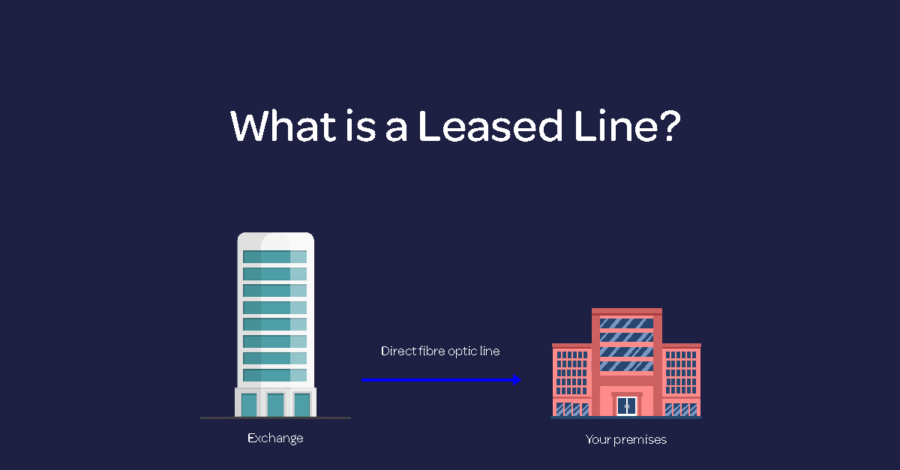
What is a leased line? In simple terms, it is a private internet connection dedicated to one organisation. You do not share its bandwidth with nearby homes or businesses, so performance stays consistent throughout the working day. It also provides the same speed for uploads and downloads.
That combination makes a leased line useful for businesses that rely on cloud software, VoIP calls, video meetings, large file transfers or secure access for remote teams. It costs more than standard business broadband, but the price includes a more predictable service and a business-focused service level agreement.
How does a leased line work?
A provider connects your premises directly to its network, usually using fibre-optic cable. The circuit serves your organisation alone. As a result, local broadband traffic does not slow it down when other people go online.
Leased lines are symmetrical. For example, a 500 Mbps service provides up to 500 Mbps for both downloads and uploads. Standard broadband often gives much less upload capacity, which can become a bottleneck when teams send files, back up data or host calls.
You also choose a committed speed that suits the business. Available speeds and bearer options vary by provider, address and local infrastructure, so a supplier will check the site before confirming the service.
What is the difference between a leased line and business broadband?
The main difference is whether you share the connection. Business broadband normally uses infrastructure shared with other customers. It can offer strong download speeds at a lower price, but speeds may vary and uploads are often slower.
A leased line reserves bandwidth for your organisation. It usually comes with symmetrical speeds, monitoring and a service level agreement that sets out support and repair targets. Therefore, it is better suited to work where a reliable connection matters more than the lowest monthly cost.
Neither option is automatically right for every business. A small team using email and web-based tools may be well served by business broadband. A larger office, or a company that cannot work during an outage, may find the extra assurance of a leased line worthwhile.
Advantages of a leased line
Consistent, dedicated bandwidth
Your chosen bandwidth is available to your premises rather than shared with neighbouring users. This helps calls, cloud applications and other essential services perform consistently, even at busy times.
Equal upload and download speeds
Fast uploads matter when colleagues send large files, use online backups, publish media or work in cloud-hosted systems. Symmetrical speeds remove the sharp upload limit found on many broadband packages.
Better support for VoIP and video
Voice and video traffic needs low delay and steady capacity. A well-configured leased line can support clearer calls and smoother meetings, especially when several people use them at once.
A business service level agreement
The service level agreement, or SLA, explains how the provider monitors faults, responds to incidents and works towards restoration. Read the details carefully, because response times and compensation terms differ between packages.
Room to grow
Businesses can choose capacity around their current needs and future plans. In some cases, the provider installs a bearer with spare headroom, allowing the committed speed to increase later without replacing the whole circuit.
Disadvantages of a leased line
Higher monthly cost
A dedicated circuit costs more than a shared broadband service. Prices depend on the required speed, contract term, location and engineering work. For that reason, compare the total contract cost rather than the monthly headline alone.
Installation can take longer
A new circuit may need surveys, permits or fibre construction. Straightforward installations can move quickly, while complex routes take longer. Ask for a realistic lead time and keep the existing connection active until the new service has passed testing.
One connection is not a complete resilience plan
A leased line is reliable, but no physical circuit is immune to damage or equipment failure. If staying online is critical, consider a backup service that uses a genuinely separate route or technology. Otherwise, one local incident could affect both connections.
How much does a leased line cost?
There is no single UK price because each site is different. Providers consider the premises, distance to network infrastructure, speed, contract length and any construction charges. A survey or availability check gives a far more accurate figure than a generic online estimate.
When comparing quotes, look beyond bandwidth. Check installation charges, SLA terms, support hours, router provision, monitoring, backup connectivity and what happens at the end of the contract. A cheaper quote may leave out something the business actually needs.
How long does installation take?
The timetable depends on the route into the building and the amount of engineering involved. The provider will normally survey the site, plan the circuit, complete any external work and then install and test the service. Delays can occur if the work needs landlord approval, road permits or access to shared areas.
Plan the changeover with some breathing room. In particular, avoid cancelling your current service until the leased line is live, tested and ready for normal traffic.
Is a leased line right for your business?
A leased line makes most sense when connectivity is central to daily operations. It may be a good fit if your team:
- depends on cloud applications or hosted phone systems;
- regularly uploads large files or backs up data online;
- supports many people, devices or concurrent video calls;
- needs dependable access for remote and hybrid colleagues; or
- would lose significant time or revenue during an outage.
Start with the way people actually use the connection. Measure current demand, note recurring problems and consider growth over the contract term. Then compare speed, support and resilience alongside cost. That usually leads to a better decision than choosing the largest number on a quote.
Leased line FAQs
Is a leased line the same as full fibre broadband?
No. Both may use fibre, but full fibre broadband is generally a shared service. A leased line provides dedicated bandwidth, symmetrical speeds and business SLA terms.
Can a leased line improve VoIP call quality?
It can provide the stable bandwidth and low delay that VoIP needs. However, call quality also depends on the phone platform, local network, equipment and configuration.
Does a leased line include Wi-Fi?
Not necessarily. The leased line brings connectivity to the premises. Your router, switches and wireless access points distribute it around the building, so check which equipment and setup the quote includes.
Can several offices share one leased line?
Teams can connect sites through wider network services, but each location still needs suitable access. A provider can explain whether separate leased lines, an SD-WAN service or another design best fits the organisation.